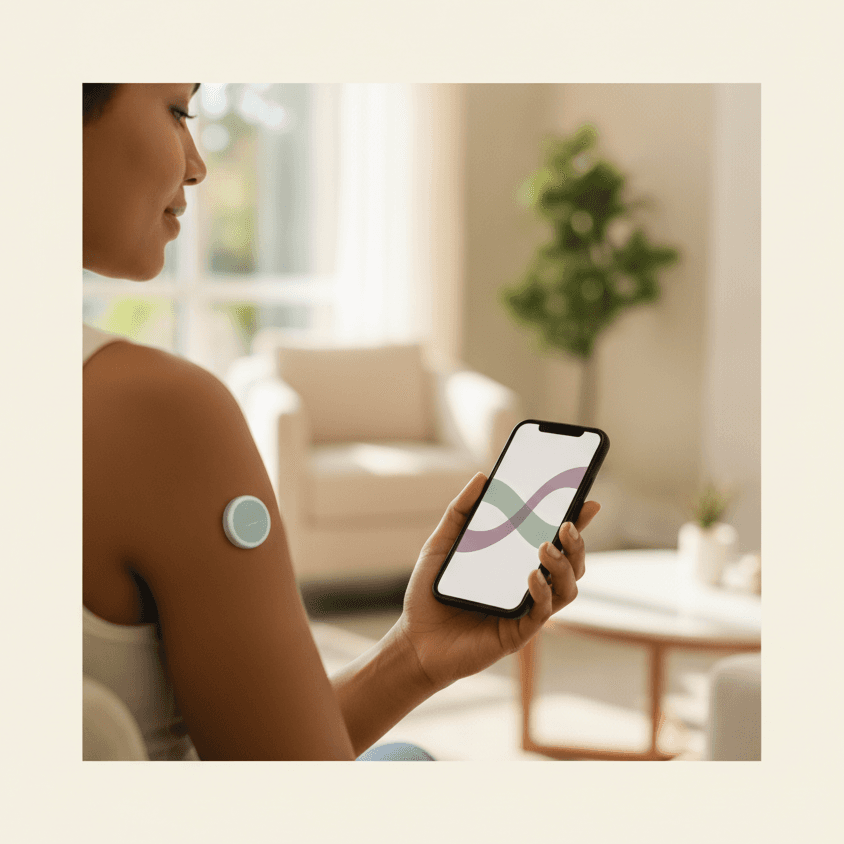
What is CGM?
A continuous glucose monitor is a small, wearable sensor that measures your glucose levels around the clock and sends readings to your phone or a handheld reader. Instead of a few finger-stick numbers a day, you get a continuous picture — including the trends and overnight patterns that finger sticks miss.
Most sensors sit comfortably just under the skin, usually on the upper arm or abdomen, and update automatically throughout the day. Many also show an arrow telling you not just where your glucose is now, but where it's headed next — so you can act before a high or low instead of after.
Benefits of CGM
For most patients, the biggest change isn't one number — it's finally seeing the whole story. Continuous data tends to make managing diabetes feel less like guesswork and more like a plan you can steer. Common benefits include:
- Spot trends and patterns — see how your glucose moves across a whole day, not just at scattered moments.
- Fewer routine finger sticks, since readings update automatically throughout the day.
- Overnight insight into highs and lows that happen while you sleep and would otherwise go unnoticed.
- Data-driven adjustments to nutrition, activity, and medication, made from real readings rather than guesswork.
- More time in range — more of your day spent in your target glucose zone, which is what we work toward together.
Who it's for
CGM can benefit many people managing diabetes — particularly those on insulin, anyone working to understand how food and activity affect their glucose, and patients fine-tuning a new treatment plan. It can also be reassuring if you experience lows you don't always feel coming, or if your numbers have been harder to predict lately.
It isn't the right fit for everyone, and that's a conversation worth having in person. During your visit we'll look at your history, your goals, and your day-to-day routine and help you decide whether CGM is worth adding — and which approach makes the most sense for you.
How it works with us
Evaluation & device selection
We review your history and goals and help choose the CGM that fits your needs and coverage.
Sensor setup & training
We apply your first sensor in-office and show you how to read the data on your phone or reader.
Review & adjust
We interpret your glucose patterns together and fine-tune nutrition, activity, and medication.
Devices we support
There are several continuous glucose monitors on the market, and the best one depends on your needs, your other diabetes technology, and what your plan covers. We'll walk you through the practical differences — how each is worn, how you view the data, and how it fits your routine — and recommend the option that suits you best.
If you already use a particular monitor or an insulin pump, bring it along — in many cases we can work with the system you already have rather than starting over.
Insurance & cost
Many insurance plans help cover continuous glucose monitoring, though coverage and out-of-pocket cost vary by plan and by how the device is supplied. Our team can help check your benefits before you commit, so you have a clear picture of what to expect rather than a surprise later.
If cost is a concern, tell us — there are often more options than patients realize, and we'd rather help you find a workable path than have you go without the data.
What to expect
Getting started is straightforward. Applying a sensor is quick and most patients describe it as a brief pinch at most; many sensors are then worn for one to two weeks before they're replaced. You can shower, sleep, and stay active as usual while wearing one.
We'll handle the initial setup, help confirm your coverage, and make sure you're comfortable reading your data before you leave. At follow-ups we review your patterns together and adjust nutrition, activity, and medication as needed — so every reading turns into a better decision, not just more information.
Sources & further reading
- American Diabetes Association — Devices & Technology
- NIDDK (NIH) — Continuous Glucose Monitoring
- FDA — Blood Glucose Monitoring Devices
This page is for general education and isn't a substitute for personalized medical advice. Always talk with a qualified clinician about your individual care.